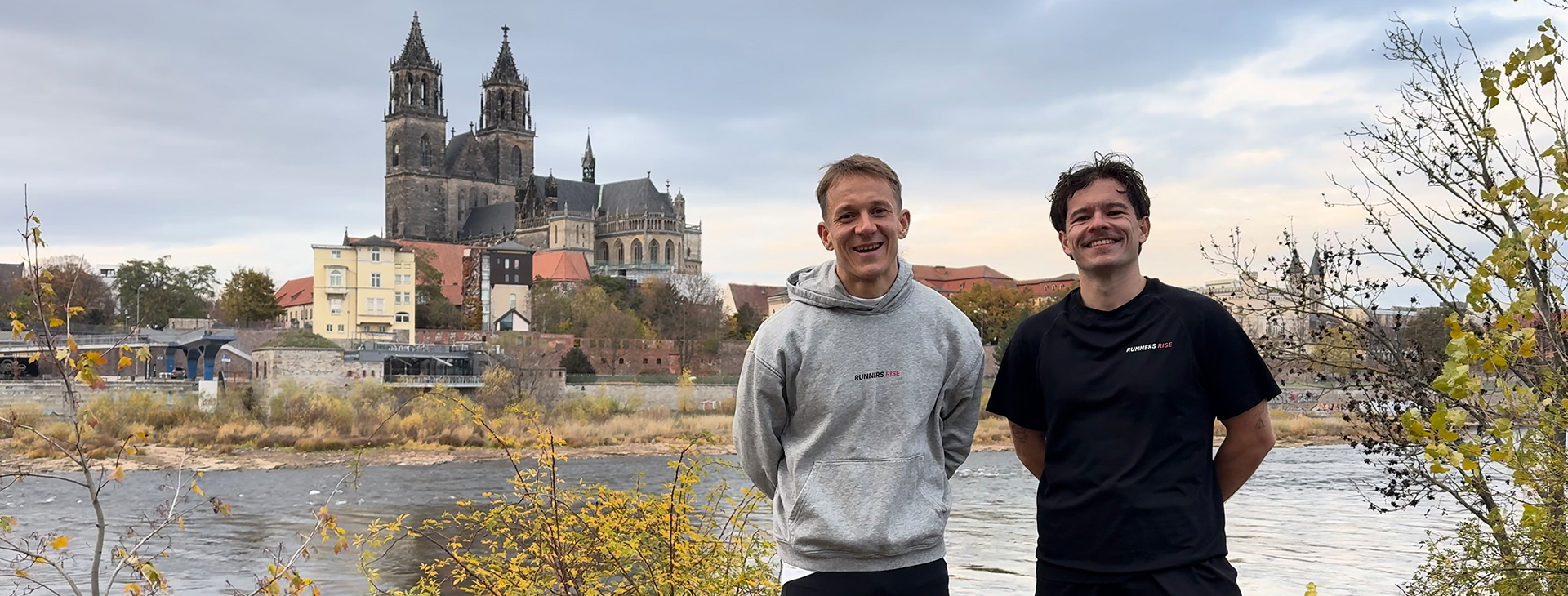
Every kilometre can bring you closer to the top: with their app, Runners Rise, Felix Werk and Lucas Häußer aim to motivate people to go running. The pair studied at the University of Magdeburg and are now hoping to set up their own running team there.
The running shoes are ready. But is there still enough motivation for a run today? Felix Werk and Lucas Häußer want to provide an extra reason to head out the door: a better position in the league table. Their app, Runners Rise, applies the principle of sports leagues to running. There are teams, teams promoted and teams relegated. There’s no need for a joint kick-off.
Felix Werk calls the idea a “Bundesliga for running”. It’s not the pace that counts, but the number of kilometres covered. People with a similar running workload are meant to compete against one another. The hope behind this is that anyone who has a chance of keeping up with the leaders is more likely to stick with it.
From taking up sport to a triathlon
“We’re both coming out of a phase where we weren’t very active. So we both know exactly what it feels like to start right from the bottom,” says Felix Werk. Nevertheless, they both managed to complete an Ironman.
The triathlon in Hamburg brought them together. They trained together, became friends and both crossed the finish line. After that, it was clear: they wanted to build something together off the course as well.
They are both linked by their studies at the University of Magdeburg. Felix Werk moved to the city from Berlin in 2014 and studied Industrial Engineering, specialising in Mechanical Engineering, for both his Bachelor’s and Master’s degrees. Today, the 35-year-old works as an asset manager for an energy contractor; he is married and a father.
Lucas Häußer came to Magdeburg in 2021 to study for his Master’s in Mechanical Engineering, specialising in Automotive Systems. As chair of the student council, he organised the freshers’ weeks and revived the suspended canteen party.
For their joint project, they chose running. “It’s the sport that almost anyone can do. Just put on your trainers and off you go,” says Felix Werk.
Accumulate kilometres, make up ground
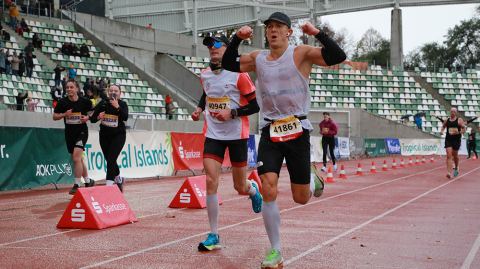
At major running events, professionals and amateur runners often share the same course. For many, therefore, the main thing is simply to finish or to beat their personal best. Runners Rise aims to create a competition alongside this, in which top placings seem achievable.
“As a runner, you compare yourself to others anyway, but you do so realistically and not against benchmarks that tend to be demotivating,” explains Felix Werk. The leagues are therefore designed to bring together people who run a similar number of kilometres.
To do this, the app connects to a service such as Apple Health or Health Connect. Recorded runs are automatically transferred, and the kilometres covered each month are entered into a table. “Those at the top move up a division; those who run too little are relegated. And then the race for promotion starts all over again,” says Felix Werk. Special challenges, such as a half-marathon, earn extra points.
In the long term, participants could work their way up from local leagues all the way to the German league. Those who prefer to stay local could compete for the Magdeburg city championship.
The concept is deliberately reminiscent of mobile games: progress is visible, and new goals await. But the next success can’t be achieved from the comfort of the sofa. If you want to get ahead, you have to run.
A running team for the University of Magdeburg?
Teams can also compete against one another. In the app, they’re called ‘Communities’. To ensure that large teams don’t win simply because of their numbers, the number of participants counted towards the score is based on the smaller team. On both sides, the members with the most kilometres count.
Felix Werk and Lucas Häußer would like to see a community like this at the University of Magdeburg too. Students and staff could collect kilometres together. To do this, one person would first need to apply to set up the team as the ‘Running Captain’. Other members could join via an invitation link or code. A university league would also be technically feasible – for example, with teams from the University of Magdeburg and Magdeburg-Stendal University of Applied Sciences.
Developing after work
The biggest challenge in building the app was time. “Runners Rise is being developed in the evenings, at weekends and in every spare minute in between,” says Felix Werk. Lucas Häußer handles the programming, databases and servers. Felix Werk takes care of marketing, partners and sponsors, amongst other things. The structured approach to work they learnt during their studies is helping both of them with this.
Following tests with their wives, friends and acquaintances, the app was released on the Apple App Store at the end of September and on the Google Play Store at the start of October. According to Felix Werk, 1,500 people are now using the free app.
The after-work project is set to become a business. Partnerships could generate revenue, for example through naming rights for a league. The core of the app is to remain free. Felix Werk has already reduced his working hours. The next big goal therefore lies beyond the running track: eventually being able to make a living from Runners Rise.
Article text...